

More than just a box-office success, Alfred Hitchcock’s Psycho (1960) marked a moment of redefinition, pushing the boundaries of the horror genre and reshaping what cinematic horror was allowed to articulate. Remembered for the unapologetic brashness of its infamous shower scene, an exposition of violence and transgression which extends across the course of the movie, Hitchcock’s daring film is steeped in psychoanalytic commentary – most noticeably, this essay contends, in its treatment and characterisation of Freud’s work on “Das Unheimliche”, or “The Uncanny” (Freud, 1919). Freud understands the uncanny as “that class of the frightening which leads back to what is known of old and long familiar” (Freud, 1919), and Hitchcock’s film often engages with this return of repressed, yet ‘long familiar’ ideas, dealing with iterations of recognisable figures and motifs then fractured and perverted, but still eerily familiar.
Freud explores the uncanny, in part, through the lens of the doppelganger. Born out of the narcissism of children, who create projections of themselves in order to achieve a sense of immortality, the doppelganger provides a comforting “double” to the child, but later returns as a “harbinger of death”, an unsettling reminder of the finitude of the self, and a return to this repressed, primitive state of self-love, now experienced as alien and terrifying (Boyle, 2016). Hitchcock’s Psycho is attuned to the repression and the terror of the doppelganger, and the film offers Norman and Mother, as well as Norman and Marion, as examples of this uncanny doubling, its manifestation of repression, and its resultant sinister implications. This essay intends to begin by laying out Freud’s understanding of the Uncanny and the Double in full, before turning to Psycho to explore how these uncanny relationships illuminate Freud’s theory, and demonstrate its unsettling consequences.
Freud’s work on the Uncanny is rooted in his 1919 essay, “Das Unheimliche”. In this paper, Freud articulates his theory of the uncanny, as something which is “in reality nothing new or alien, but something which is familiar and old-established in the mind, and which has become alienated only through the process of repression” (Freud, 1919). This process of repression is crucial for Freud’s account – only that which has previously been repressed can re-emerge in unsettling form. This is what gives the uncanny experience its potency; something which feels familiar because it is indeed familiar, yet through repression the agent is unable to recollect this past experience, and so their familiarity becomes eerie and unsettling. Freud notes that the particular elements we repress are often linked to infantile fears and anxieties – drawing on E.T.A Hoffmann’s The Sandman (1816), Freud explores the symbolism of losing one’s eyes as an uncanny, repressive substitute for castration anxiety, the infantile fear that, upon discovery of the sexual organs, one might lose them.
Freud also notes how the uncanny experience of the doppelganger can be recollective of an infantile fear, since repressed. He links the concept of the “double” to the child’s early-stage narcissism, in which they project multiple versions of themselves as a form of self-preservation, with the intention of achieving immortality. Therefore, encountering an uncanny double in adulthood becomes an unsettlingly familiar experience, a return to the since-lost primitive stage. This also acts as a threat to the now developed adult sense of self, forcing the agent to confront the coexistence of the self with their infantile “projections”. Freud uses the example of the doppelganger in his foundational work, to demonstrate how uncanny experiences, and the repression required to make it so, are borne out of infant fears and anxieties.
Freud’s notion of the uncanny is particularly applicable to the enterprise of cinema as a whole, due to the inherently duplicating function of the camera. To record some event or person is fundamentally to duplicate reality, imagining bodies, people, places, and events both as they are and within a cinematic or photographic context. This blurs the line between reality and representation, an uncanny image which is at once real, yet also a projection of something more basic and fundamental. This cleanly integrates with Freud’s notion of the uncanny as a return, somewhat distorted or maligned, of a previous experience (Causey, 1999).
The camera also works as a fragmenting device, capable of focusing solely on – and so separating out – specific parts of the body, either through editing, shot framing, or close-up zoom. The camera is capable of turning the human whole into a series of disjointed fragments, defamiliarizing the body and turning the usually cohesive “person” into something object-like. Particularly in the horror genre, which utilises close-up zooms on hands, faces, or reflections, the fragmentary effects of the camera are a cinematic manifestation of the kind of unsettling unfamiliarity which Freud articulates in his theory of uncanny doubles.
Finally, we can understand how Freud’s notion of uncanny doubles might be particularly relevant to Hitchcock’s Psycho. The film concerns itself with these doubling effects, and their uncanny consequences; linking itself to ideas of surveillance, mirror images, and split-identities. To understand the link between Freud’s theory and Hitchcock’s production in greater clarity, this essay now turns to the particular uncanny doubles of Norman and Mother, and Norman and Marion.
Mother’s uncanny doubling is found in the return to the infantile aggression and control from which Norman has attempted to distance himself. For Norman, Mother represents both the darker aspects of his self and the disavowed other, revealing what Norman cannot accept in himself, such as his sexual impulses or aggression, which in turn makes the familiar – his own self – strange and uncanny. Importantly, the ‘Mother’ persona originates only after Norman kills her physical self – we can read this formation of the ‘Mother’ double in the typical Freudian sense, of a child attempting to project immortality by extending their conscious self onto another object. Only, in this case, Norman engages with the double not for the immortality of his own likeness, but in order to keep Mother alive. He gives her “half of his life”, creating a psychic double which blurs the lines between his own sense of self and the maternal other (Green, 1999). However, perhaps Norman’s immortalising is more self-interested than first appears; we could also read his projection of the ‘Mother’ personality as a way to keep the darker aspects of the psyche alive, yet distant from his conscious self. On this view, Mother functions as a toxic amalgamation of all of Norman’s twisted or repressed desires, fears, beliefs, and dispositions – she contains the worst of him, that which he wishes not to face consciously but cannot discard.
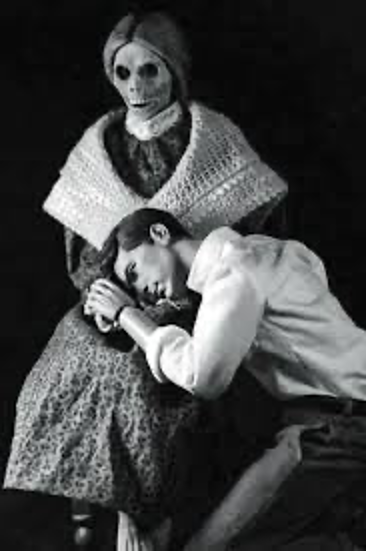
Figure 1 (Hitchcock, 1960)
Norman’s doubling of Mother allows him to remain in the infant role; in the above frame, taken from a publicity shot before the movie’s release, Norman coddles the evidently-dead figure of Mother like a young child. Yet far from gently maternal, Norman’s double of Mother functions like the punitive superego (Cherry, 2023) – her voice polices Norman’s desires, reprimanding him for his attraction to women like Marion. Here, the externalisation of Norman’s inner censorship, guided by the superego, produces the uncanny effect – his own consciousness projected onto an object, acting in the world. Norman’s experience of Mother is both protective and mystifyingly cruel, reminiscent of his childhood relationship with her, and we can observe the uncanny return of the conflict and persecution which Norman has long since repressed in the way that he interacts with his own projection of Mother.
Mother’s house has three floors, basement, ground, and first, and Žižek notes the way in which the first floor of the house, where Mother’s bedroom is, takes up the position of the superego, watching and reprimanding Norman for his immorality. Even after her death, Mother’s persona – but not her body - exists in the mind of Norman on this floor as a judicial reminder of his accountability to and inseparability from her, manifesting in his constant guilt and sense of prohibition (Cohen, 1995).
On the ground floor, Norman acts as the ego, engaging with the outside world normally – careful to hide his darker psychological traits. This is the conscious, everyday personality which he projects, free from both the arcane rule of his Mother persona, and his baser, immoral desires of the floor below.
In the basement resides the skeletal body of Mother – his dark secret that he keeps locked away from his conscious psyche; this is the realm of the id, and Norman acts on his most primitive and immoral desires on this floor. In a key moment of the film, Norman transports Mother’s skeletal remains from the first floor to the basement, which we can read as a psychological attempt to remove her from the influential pedestal of the superego and banish her to the hidden id, in Norman’s desire to control Mother’s influence over his own self (Žižek, 1992).
Norman’s relationship to Mother provides the most blatant and primitive uncanny doubling in Psycho – an infantile projection of repressed desires and immoral beliefs. To explore the notion of uncanny doubles in Psycho completely, this essay now turns to look at the relationship between Norman and Marion, and the doubling between them.
Firstly, we might note overtures of similarity between Norman and Marion – both characters can be seen as trapped in their circumstances and fantasising about escape, using secret transgressions to do so. While Marion steals money in order to achieve this end, wishing to be able to marry her fiancée and have a respectable dinner, Norman’s transgression is darker, killing those who threaten his bond with Mother. We might read Marion’s aspiration as that of “contemporary American culture” – a desire for the kind of personal and familial autonomy achieved only by financial freedom, with Norman’s transgressive act – the ultimate act of autonomy - representing a dark conclusion to what Marion might have become, had she played out the complete end of her desires. Hitchcock also changed the names of the characters from the original text, so that “Norman” and “Marion” share almost all the same letters, hinting further at their uncanny intertwinement. Žižek describes the link between the two as a twisted Möbius strip – if we progress far enough along Marion’s story, we end up with Norman – the strip has been twisted, and Norman revealed as Marion’s “nocturnal reverse” (Žižek, 1992). For the first 50 minutes of the movie, it seems as though Marion Crane is the eponymous ‘psycho’. We might ask why such a large portion of the movie is dedicated to setting up the backstory of the murder victim, who at this point is the unquestioned protagonist in the movie. However, Norman takes over as protagonist by killing her, and so twisting the strip. In her quest to become normal – the autonomy-driven reason for stealing the money and fleeing in the first place – Marion succeeds only in becoming Norman. Having progressed far enough along Marion’s story, we are left with Norman.
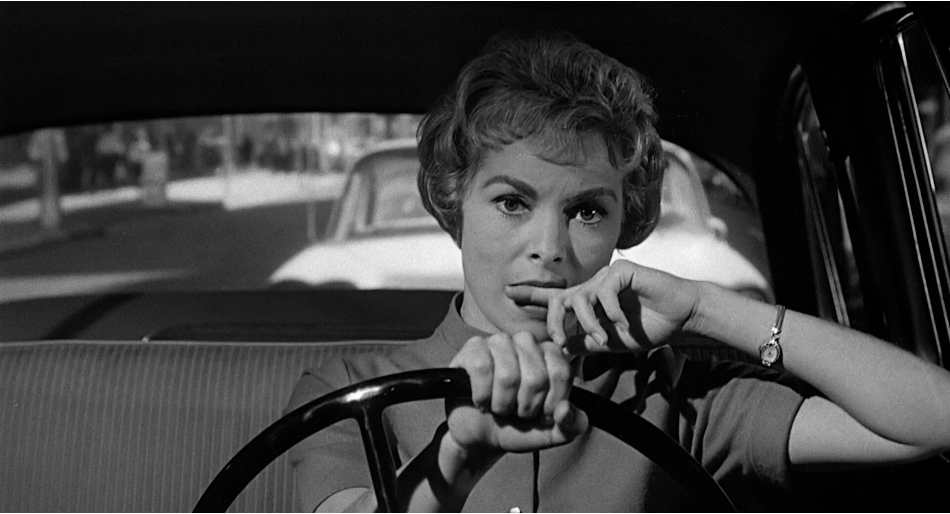
Figure 2 (Hitchcock, 1960)
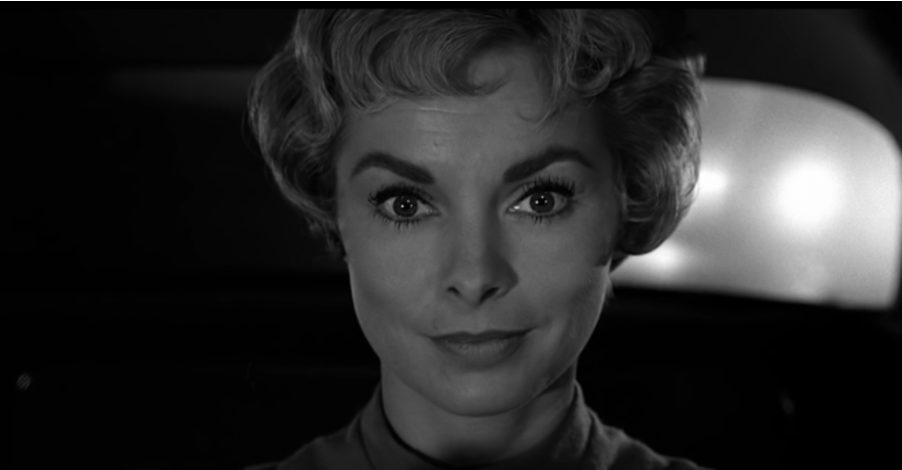
Figure 3 (Hitchcock, 1960)
Hitchcock uses the camera and subtle editing to hint at further doubling between Norman and Marion. On the run after stealing a cash sum from her boss, Marion drives until nightfall, where she checks in to the Bates motel. It is on this car journey, before they ever meet, that Hitchcock cinematographically presents Marion as a doppelganger to Norman.
Both Figure 2 and Figure 3 are taken from Marion’s car journey on the way to the Bates Motel. At the start of the journey, in the daytime, we see all of Marion’s face, evenly lit. Time passes in fades, not cuts, and we have a regular depth of field. Hitchcock uses these techniques to show that we are still in an objective reality, that of Marion’s world. Contrast that with Figure 3; as day passes and night falls, time moves in cuts, not fades. There are shadows strewn across Marion’s face, and the depth of field flattens. We are no longer seeing the world as Marion does on the outside; we are leaving her objectivity behind, and entering the subjective reality of Norman’s nocturne. We have progressed to the other side of the Möbius strip. Finally, as she approaches the motel, Marion’s face takes up almost the entirety of the screen. At the last moment, we see a smile leak out across her face, a smile eerily familiar to Norman’s famous smile:
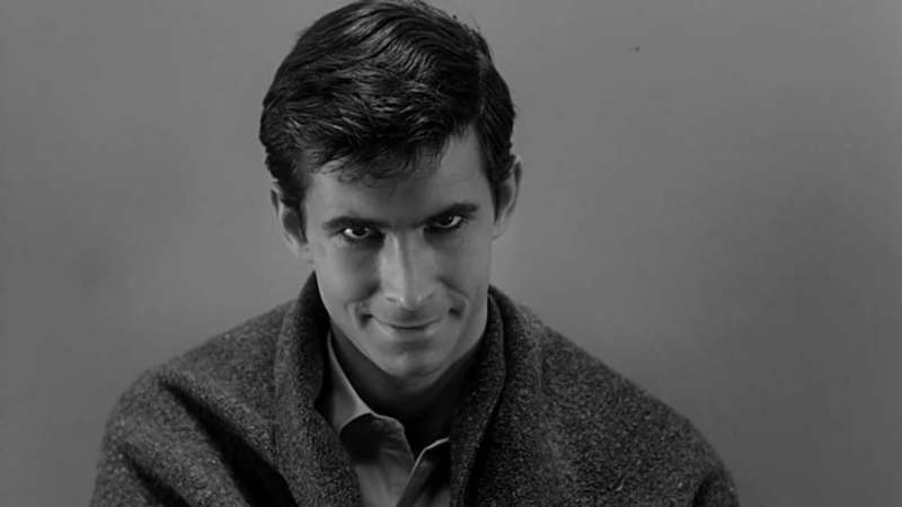
Figure 4 (Hitchcock, 1960)
As Marion approaches the Bates motel, she becomes Norman. And, as Norman kills Marion and takes over from her as protagonist, he becomes Marion. Both characters represent two sides of the same coin, the Möbius strip of repressed desire and corrupting ambition which drives them to immoral action. Though they both present as polite and unproblematic – the shy motel owner and the respectable secretary – both are revealed to be capable of deception and of violence, demonstrating the unsettling, uncanny effect that ordinary people may contain their own monstrous double, buried in the depths of the id or projected onto another object. Hitchcock perfectly juxtaposes Norman and Marion to demonstrate Freud’s explanation of how the uncanny plays with immoral desire, repression, and projection (Leicester, 2024).
To Freud, the double is uncanny not just as a reminder of death and childhood desire, but when it externalises hidden wishes or fears; this is another way in which we can note the uncanny link between Norman and Marion. Though Marion flirts with crime, but ultimately repents, Norman shows no such sensitivity – he fully inhabits a corrupted, criminal self, divided between reality and his own subject. In this way, we can read Norman as the return of Marion’s repressed and disavowed desires, in monstrous form – the “nocturnal reverse” of taking Marion’s life of “contemporary American culture” to its extreme end. The Norman / Marion double demonstrates how a seemingly normal self can contain a repressed double; what appears a complete other – the murderer of Norman – is actually an uncanny echo of the familiar self – the respectable woman, Marion, who momentarily crosses a line. Norman represents an uncanny extension of what has been inside Marion all along, but simply repressed.
Hitchcock’s Psycho is a revolutionary horror movie well-versed in psychoanalytic theory. Even the final shot, with Norman’s Mother personality taking over his internal monologue, contends with an uncanny doubling. We’ve come full circle - opening with a neurotic, dissatisfied woman concealing a crime, and ending with one, only this woman is now nothing more than an extension of Norman’s repressed fears and desires. Blurring the lines between subject and object, between perpetrator and victim, and between parent and infant, Hitchcock weaves together cinematographic techniques, narrative structures, and cultural similarities to hint at uncanny doubles between Norman and Mother, and between Norman and Marion. He does so with an exploration of their origins and effects which lines up with Freud’s theory on the matter, and with a precision and sensitivity which makes the intention clear.
BIBLIOGRAPHY
Boyle, J. (2016) ‘Esoteric Traces in Contemporary Psychoanalysis.’ American Imago 73 (1) https://www.jstor.org/stable/26305138.
Causey, M. (1999) ‘The Screen Test of the Double: The Uncanny Performer in the Space of Technology’, Theatre Journal, 51(4).
Cherry, B. (2023) ‘Freud’s Superego in Psychology, VeryWellMind, https://www.verywellmind.com/what-is-the-superego-2795876
Cohen, T. (1995) Hitchcock and the American Sublime, Cambridge: Cambridge University Press.
Freud, S. (1919) ‘The “Uncanny”’, in The Standard Edition of the Complete Psychological Works of Sigmund Freud, Vol. 17, translated by J. Strachey. London: Hogarth Press.
Green, A. (1999) The Fabric of Affect in the Psychoanalytic Discourse, London: Routledge.
Hoffmann, E.T.A (1816), “The Sandman”, Night Pieces, Germany: Verlag Georg Reimer.
Hitchcock, A. (1960) Psycho [Film]. USA: Paramount Pictures.
Leicester, M. (2024) ‘Hitchcock’s Figurations: Some Reflections on Textuality in Psycho’, AHOAJ, 12(1).
Žižek, S. (1992) Everything You Always Wanted to Know About Lacan (but were afraid to ask Hitchcock), London: Verso.