

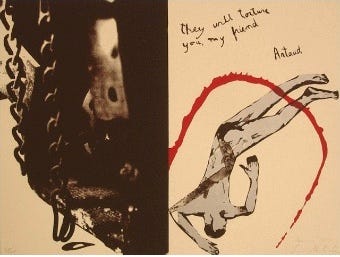
The Return of Artaud Le Mômo
The anchored spirit,
screwed into me
by the psycho-
lubricious thrust
of the sky
is the one who thinks
every temptation,
every desire,
every inhibition.
o dedi
o dada orzoura
o dou zoura
a dada skizi
o kaya
o kaya pontoura
o ponoura
a pena
poni
It’s the penetral spider veil,
the female onor fur
of either or the sail,
the anal plate of anayor.
(You lift nothing from it, god,
because it’s me.
You never lifted anything of this order from me.
I’m writing it here for the first time,
I’m finding it for the first time.)
Not the membrane of the chasm,
nor the member omitted from this jism,
issued from a depredation,
but an old bag,
outside membrane,
outside of there where it’s hard or soft.
B’now passed through the hard and soft,
spread out this old bag in palm,
pulled, stretched like a palm
of hand
bloodless from keeping rigid,
black, violet
from stretching to soft.
But what then in the end, you, the madman?
Me?
This tongue between four gums,
this meat between two knees,
this piece of hole
for madmen.
Yet precisely not for madmen.
For respectable men,
whom a delirium to belch everywhere planes,
and who from this belch
made the leaf,
listen closely:
made the leaf
of the beginning of generations
in the palmate old bag of my holes,
mine.
Which holes, holes of what?
Of soul, of spirit, of me and of being;
but in the place where no one gives a shit,
father, mother, Atraud, artoo.
In the humus of the plot with wheels,
in the breathing humus of the plot
of this void,
between hard and soft.
Black, violet,
rigid,
recreant
and that’s all
Which means that there is a bone,
where
god
sat down on the poet,
in order to sack the ingestion
of his lines,
like the head farts
that he wheedles out of him through his cunt,
that he would wheedle out of him from the bottom of the ages,
down to the bottom of his cunt hole,
and it’s not a cunt prank
that he plays on him in this way,
it’s the prank of the whole earth
against whoever has balls
in his cunt.
And if you don’t get the image
and that’s what I hear you saying
in a circle,
that you don’t get the image
which is at the bottom
of my cunt hole,-
it’s because you don’t know the bottom,
not of things,
but of my cunt,
mine,
although since the bottom of the ages
you’ve all been lapping there in a circle
as if badmouthing an alienage,
plotting an incarnation to death.
ge re ghi
regheghi
geghena
e reghena
a gegha
riri
Between the ass and the shirt,
between the gism and the under-bet,
between the member and the let down,
between the membrane and the blade,
betweeen the slat and the ceiling,
between the sperm and the explosion,
‚tween the fishbone and ‚tween the slime,
between the ass and everyone’s
seizure
of the high-pressure trap
of an ejaculation death rattle
is neither a point
nor a stone
burst dead at the foot of a bound
nor the severed member of a soul
(the soul is no more than an old saw)
but the terrifying suspension
of a breath of alienation
raped, clipped, completely sucked off
by all the insolent riff-raff
of all the turd-buggered
who had no other grub
in order to live
than to gobble
Artaud
mômo
there, where one can fuck sooner
than me
and the other get hard higher
than me
in myself
if he has taken care to put his head
on the curvature of that bone
located between anus and sex,
of that hoed bone that I say
in the filth
of a paradise
whose first dupe on earth
was not father nor mother
who diddled you in this den
but
I
screwed into my madness.
And what seized hold of me
that I too rolled my life there?
ME,
NOTHING, nothing.
Because I,
I am there,
I’m there
and it is life
that rolls its obscene palm there.
Ok.
And afterward?
Afterward? Afterward?
The old Artaud
is buried
in the chimney hole
he owes to his cold gum
to the day when he was killed!
And afterward?
Afterward?
Afterward!
He is this unframed hole
that life wanted to frame.
Because he is not a hole
but a nose
that always knew all too well to sniff
the wind of the apocalyptic
head
which they suck on his clenched ass,
and that Artaud’s ass is good
for pimps in Miserere.
And you too you have your gum,
your right gum buried,
god,
you too your gum is cold
for an infinity of years
since you sent me your innate ass
to see if I was going to be born
at last
since the time you were waiting for me
while scraping my absentee belly.
menendi anenbi
embenda
tarch inemptle
o marchti rombi
tarch paiolt
a tinemptle
orch pendui
o patendi
a merchit
orch torrpch
ta urchpt orchpt
ta tro taurch
campli
ko ti aunch
a ti aunch
aungbli
Antonin Artaud, le Momo
Best known for his work on the Theatre of Cruelty, Artaud’s writing was a kind of performance, designed to assault the senses and force the audience into confrontation with some uncomfortable perspectives. Artaud was unwillingly committed to several mental institutions from 1937 to 1946, where he was giving electroshock therapy, stripped of his possessions and hair, and severely underfed. When he re-entered society, forever changed, he wrote Artaud le Momo as a furious accusation at the power structures and institutions which had taken from him his subjectivity and identity over those hard years.
“Momo” is Marseille slang for the village idiot or fool, and Artaud uses this term as a kind of reclamation, shrugging off the clinical and psychoanalytic definitions of “schizoid” or “‘madman” that he has been described by thus far.
Artaud’s fear of subjectivity - in the sense of becoming an Other to a different subject - reflects the typical schizoid defence mechanism. Melanie Klein characterised the schizoid-phase of infant development as an inability to experience ambivalent, or love and hate relations to the same object. As such, the object that the infant experiences as bad, it wishes to annihilate; the object it experiences as good, it wishes to consume for itself - both are violent relationships. The infants violent projections onto the bad object are consequently introspected, as therefore the infant fears that the bad object is going to do to it, what it will do to the bad object; thus this relationship is both predatory and persecutory, with the schizophrenic as both hunter and victim.
Artaud’s fear of subjectivity is a fear regarding the annihilation of the self, of identity, of his “whole without a frame, that society tries to frame”. It represents the schizoid desire to be in bits and pieces, a whole without parts, a body without limbs, a being without origin. Artaud fears the establishment which has tried so hard to categorise, contain, and complete him - he defends against this definitionalisation, this desire for neat lines.
This is because the schizoid, in its violent relationship with love-objects and hate-objects (all of which make up, in its entirety, its experience of the world) protects itself by disregarding the proper rules of conversation and speech and retreating to a private, “foreign” language, often intelligible only to the schizophrenic. In ‘le Momo’, Artaud treats words as breakable, malleable - just as he sees the body, with the penis often seemingly interchangeable with the tongue, and other limbs. Artaud approaches words in this way, rearranging words, deliberately misusing words (glossolalia), and creating nonsense phonemes. He breaks language apart, in the same way that he sees the proper potential of the body as something breakable, designable, modular.
Lacan notes that to be a speaking-being is to surrender some of one’s personal freedoms. By engaging in the rules and conventions that guide speech and conversation, we limit our freedoms of total exercise over our speech faculties and our bodies. You could, physically and intellectually, respond to “where is the nearest bathroom” with “it’s twelve past midnight”, but you wouldn’t. It breaks a convention, and violates the expectations of the interlocutor in what conversation generally yields. These are the freedoms that Lacan notices are impinged by our participation as a speaking-being.
The schizophrenic, then, protects their freedoms by disregarding these conventions and expectations. In their private language, the schizoid is free to play with word and sound as they wish, with no restriction. This contributes to the schizophrenic’s ideal of being without origin, existing without dependents, and being inside and out - integrated in society without being subject to its social laws. The whole without a frame.
A note on circularity
Another of Artaud’s aims with this poem is to make it hugely difficult to read. He is certainly successful in this endeavour. But it is difficult by design - Artaud believes that easily digestible poetry is already domesticated; in le Momo, the resistance is the meaning, another plea to be left among from the neat characterising and subjugating that has dominated Artaud’s life. In trying to analyse it for its themes, ideas, and context, it is unclear that we are not doing exactly that. This is certainly not what Artaud would’ve wanted for this poem - its transformation from parts into a whole, a cohesive idea, a thesis statement. Artaud would’ve rebuked the idea of summarising, drawing together the major themes of this sprawling poem into a single, parenthetical idea.
Whether Artaud is frustrated in this way or not, it is clear he achieves one thing; the poem draws out with startling clarity the experience of the schizoid-mechanisms in the patient, in a way that William Burroughs or Nico Walker has done for the heroin addict. Artaud’s frantic, hurtling rhetoric is both symptom and performance, representative of his clinical past, and yet also playing up on those previous experiences for dramatic effect. Neither one has to be disingenuous. Artaud is furious - with god, with society, with corporate psychology and therapeutic establishments - and his foaming at the mouth is not merely the ramblings of a madman, but the exclamations of a heightened sensitivity.
The madman is a dreamer awake - Sigmund Freud.
Readings, by Artaud
[27:02]
"The schizoid breaks language conventions" is a great way of saying it's utterly incomprehensible